
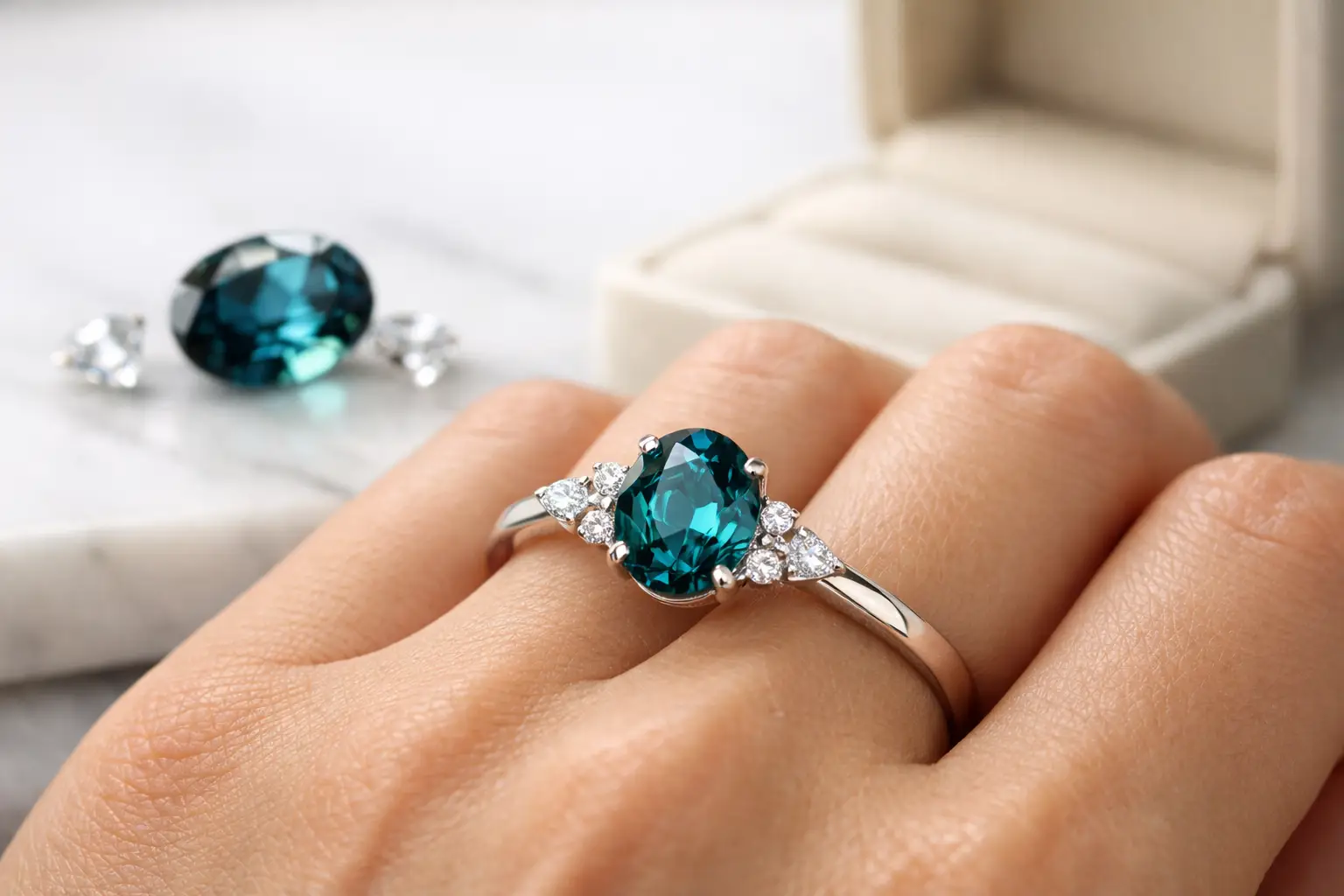
A teal sapphire engagement ring has a quality that diamonds and traditional blue sapphires rarely share: it changes with the light without losing its character. In one moment, the stone may show deep ocean blue; in another, rich green, forest, or a subtle gray-blue veil. For couples drawn to a ring that feels personal rather than prescribed, teal offers remarkable depth.
The appeal is not simply that teal is different. A fine natural sapphire in this color family can carry both presence and restraint. It feels modern, yet sapphire has been valued for centuries as a gem of strength, rarity, and enduring beauty. The result is an engagement ring that is distinctive enough to recognize across a room, but nuanced enough to keep revealing new details over time.
What Makes Teal Sapphire So Compelling?
Teal is not one fixed sapphire color. It describes a meeting point between blue and green, sometimes with traces of yellow, gray, or steel. One stone may lean toward a cool blue-green, while another has a more verdant, mossy character. This variation is precisely why selecting a teal sapphire should be a considered process rather than a search for a single standard shade.
Sri Lanka, historically known as Ceylon, is one of the world’s most important sources of fine sapphires. Its gem gravels produce sapphires in an exceptional range of colors, including elegant blue-green and teal stones. Natural Ceylon sapphires are especially admired for their lively crystal, often showing brightness and color movement rather than a flat, uniform appearance.
A teal sapphire can also offer a compelling alternative for those who find a classic royal-blue sapphire too formal, or an emerald too delicate for everyday wear. Sapphire ranks 9 on the Mohs scale of hardness, second only to diamond, making it a highly practical choice for a ring intended to be worn often.
Choosing a Teal Sapphire Engagement Ring
The best stone is not necessarily the bluest, greenest, largest, or darkest. It is the one whose color, proportion, and personality suit the person who will wear it. Viewing a sapphire in different lighting is essential. Daylight often reveals the cleanest balance of blue and green, while indoor light can bring out deeper, moodier tones.
Start with the color balance
Some clients seek a sapphire that reads clearly teal from every angle. Others prefer a stone that shifts between blue and green, since that variation gives the gem its individuality. Neither approach is more correct, but it helps to decide whether you are drawn to a blue-dominant teal, a green-dominant teal, or a balanced mix.
Tone matters as much as hue. Very dark stones can look dramatic, but may appear almost black in low light. Very light stones can feel fresh and airy, though they may show less saturation. Many of the most desirable teal sapphires sit in the middle: sufficiently vivid to show their color clearly, with enough brightness to remain alive on the hand.
Look for life, not just size
A sapphire’s beauty comes from more than carat weight. Cut affects how light returns through the stone, how large it appears face-up, and whether its color is evenly distributed. A well-proportioned oval, cushion, or elongated radiant-style cut can make a teal sapphire feel generous in size while preserving brightness.
Natural sapphires commonly contain inclusions, which are internal features formed during crystal growth. These may include fine silk, tiny crystals, or feather-like marks. Inclusions are not automatically a flaw. They can be evidence of natural origin, and in an untreated sapphire, they are often part of what makes the stone distinctive. The key is whether they interrupt beauty, durability, or transparency when viewed normally.
Ask about treatment and origin
Heat treatment is common in sapphires and can improve color or clarity. It is an accepted practice when disclosed clearly, and a heated stone may offer excellent beauty at a more accessible price point. Unheated sapphires are rarer because they show their appeal without human alteration. Their value depends on the quality of the individual gem, especially its color, clarity, cut, and documented origin.
For a significant purchase, ask directly whether the sapphire is natural, whether it has been heated, and what is known about its origin. A laboratory report can provide valuable reassurance, particularly for higher-value stones. It is also worth understanding that “Ceylon sapphire” refers to a sapphire from Sri Lanka, a provenance with a long and respected gemological history.
At Ceyloe, the focus is on carefully selected natural gemstones and clear conversation about the qualities that matter, from treatment status to the individual character of each stone. That transparency makes it easier to choose for genuine connection, not simply for a specification sheet.
Settings That Let Teal Take the Lead
Teal sapphire is remarkably adaptable, but the metal and setting will influence how the color is perceived. Yellow gold often warms a blue-green sapphire, bringing out olive, green, and golden undertones. It is a beautiful choice for a ring with a soft vintage or organic feel.
Platinum and white gold create a cooler frame. They can emphasize blue notes and give a teal sapphire a crisp, contemporary appearance. Rose gold is more individual: its warmth can create an appealing contrast with cooler teal stones, although it may make some green-dominant sapphires appear more muted. Seeing the loose gem against different metals is the most reliable way to decide.
A solitaire setting gives a fine sapphire space to speak for itself, especially when the stone has a strong, even color. A three-stone ring adds meaning and visual width, with diamonds, white sapphires, or complementary colored gems on either side. A halo can create greater visual presence, though it should be designed carefully so the surrounding stones do not overwhelm the sapphire’s quieter complexity.
Practicality should shape the design as well. A low-profile setting is often sensible for active hands, while a bezel or partial bezel offers added protection around the girdle. Prongs allow more light into the stone and can feel lighter visually, but they should be checked periodically as part of normal jewelry care.
How Teal Sapphires Compare With Other Engagement Stones
A teal sapphire is not the right choice for everyone, and that is part of choosing well. Someone who wants brilliant white sparkle above all may still prefer diamond. Someone who wants a pure, intensely green gem may be more drawn to emerald, while accepting that emerald generally requires more care in daily wear.
Compared with classic blue sapphire, teal is less formal and less predictable. Its color can be more complex, and two stones of similar size can look entirely different beside one another. This means buying by a photograph alone can be difficult. Accurate imagery and video are helpful, but a personal viewing, where possible, offers the clearest sense of a stone’s brightness, color shift, and scale.
Price also varies widely. A smaller unheated teal sapphire with exceptional color may be more valuable than a larger heated stone with darker tone or less lively cut. Provenance, treatment, clarity, rarity, and craftsmanship all contribute. A thoughtful budget starts with priorities: whether the goal is an unheated Ceylon sapphire, a particular size, a vivid blue-green color, or a custom setting made around the stone.
Caring for a Ring Made for Everyday Life
Sapphire is durable, but no fine gemstone is indestructible. Remove the ring for heavy lifting, gardening, gym sessions, and tasks involving harsh chemicals. Clean it gently with warm water, mild soap, and a soft brush, then dry it with a lint-free cloth.
Ultrasonic cleaning can be suitable for many sapphires, but caution is wise for stones with significant inclusions, fractures, or certain treatments. When in doubt, professional cleaning is the safer choice. An annual check of prongs and settings helps preserve a ring designed to become part of everyday life.
The most memorable teal sapphire engagement rings are not chosen because they follow a trend. They are chosen because one particular stone holds the right balance of color, light, provenance, and feeling – a natural gem whose character becomes more familiar and more meaningful with every year it is worn.
Comment (1)