
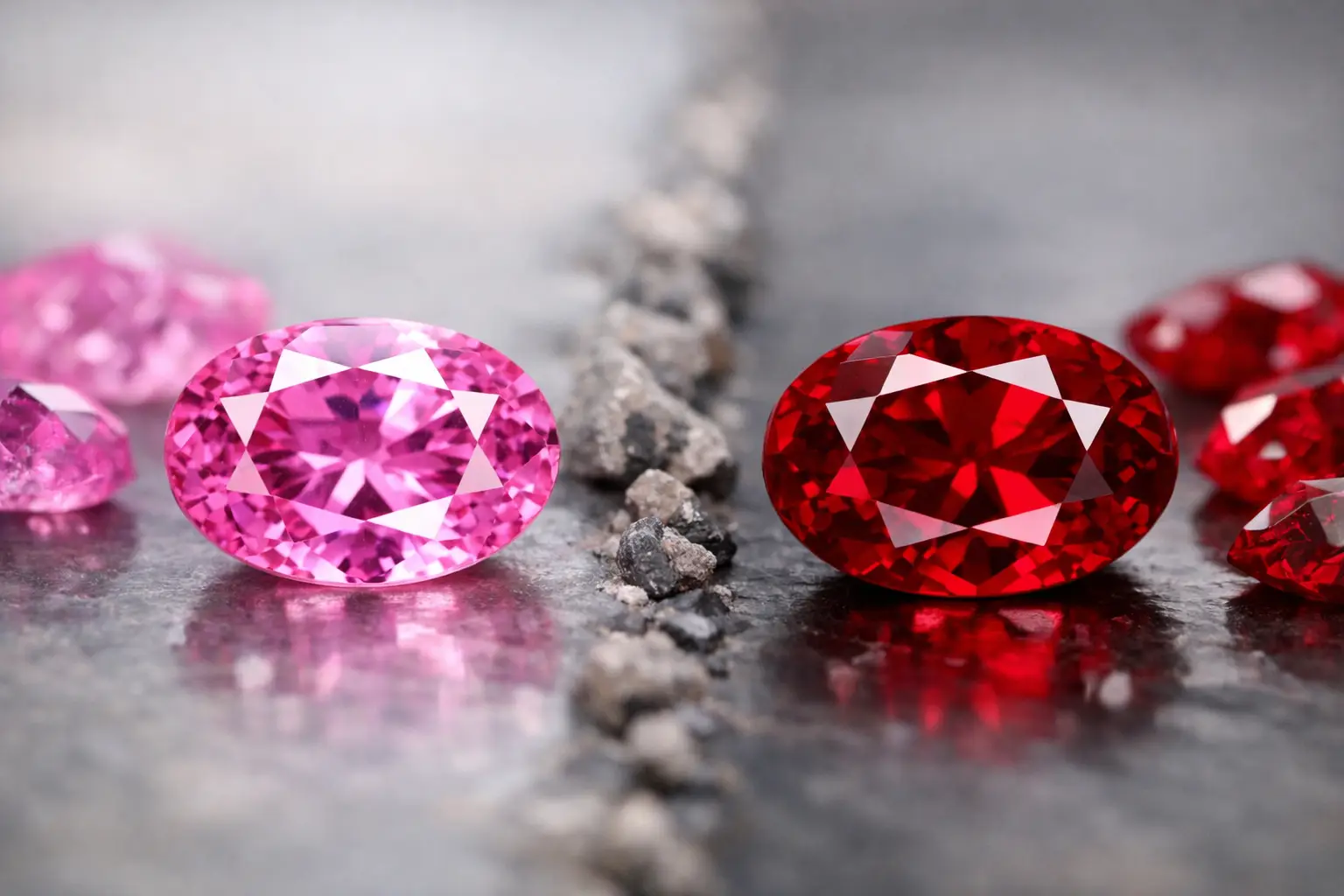
A vivid pink stone and a soft red stone may sit only a shade apart, yet the decision between them can shape the entire character of a ring. In the pink sapphire vs ruby conversation, both gems offer exceptional durability and natural beauty. The more meaningful distinction is often not technical, but personal: whether you are drawn to ruby’s concentrated red presence or pink sapphire’s lighter, more individual expression.
Both belong to the corundum family, one of the finest gemstone families for jewelry. Still, their color, rarity, market position, and the way they are valued deserve a closer look before choosing a stone for an engagement ring, custom piece, or collection.
Pink Sapphire vs Ruby: The Shared Mineral Story
Ruby and pink sapphire are both corundum, a crystalline form of aluminum oxide. Pure corundum is colorless. Trace elements give it color: chromium is responsible for the red to pink hues associated with ruby and many pink sapphires.
This shared mineral origin means they have the same hardness of 9 on the Mohs scale. For everyday jewelry, that is a major advantage. Both are well suited to rings and other pieces worn often, provided the gemstone has been selected and set with care.
The difference is chiefly one of color classification. Rubies are corundum in the red range, while pink sapphires are corundum with pink as their dominant impression. In practice, the boundary is not always perfectly clear. A stone with pinkish-red color may be called a ruby by one laboratory or market and a pink sapphire by another, depending on the strength and saturation of its red.
1. Color Is the Defining Difference
A ruby should read as red. Its finest colors combine a rich red bodycolor with brightness and sufficient saturation, without appearing too dark or overly purple. Many buyers know the phrase “pigeon blood” red, but it is not a universal standard and should never replace an assessment of the individual stone’s color, tone, and transparency.
Pink sapphires range widely, from pale blush and delicate peach-pink to vivid hot pink and deep magenta-pink. Some have a cool, purplish modifier; others show a warmer pink. Sri Lankan pink sapphires are especially admired for their lively color and light return, often with an open, luminous quality that can be beautiful in daylight.
Neither color is automatically better. Ruby makes a stronger, more traditional statement. Pink sapphire can feel softer, fresher, or more unexpected, particularly in a bespoke engagement ring. A saturated pink sapphire may also deliver striking presence without the price associated with a fine ruby.
2. Fine Ruby Is Usually Rarer and More Expensive
At the highest level of quality, ruby is among the rarest colored gemstones. A natural ruby with strong red color, attractive clarity, pleasing cut, meaningful size, and no heat treatment is genuinely scarce. That scarcity is reflected in its price, especially when the stone has a respected origin and supporting documentation.
Pink sapphire is not one single category of rarity. Pale material is more readily available, while vivid, clean, well-cut pink sapphires in larger sizes can be difficult to find. Exceptional unheated pink sapphire is rare in its own right, particularly when it has bright, balanced color rather than a sleepy or grayish appearance.
For many clients, pink sapphire offers more freedom within a given budget. Rather than compromising heavily on size or visual beauty to obtain a ruby, a buyer may choose a larger or finer-looking pink sapphire. This is not a lesser choice. It is simply a different allocation of value.
3. Treatment Status Matters for Both Gems
Heat treatment has been used for generations to improve the color and clarity of corundum. It is common in both rubies and sapphires, and a heated gemstone can still be natural, beautiful, and appropriate for fine jewelry. The essential point is transparency.
An unheated ruby or pink sapphire is not automatically superior in appearance. Some heated stones have extraordinary color and make excellent jewelry gems. However, when other quality factors are comparable, unheated stones are generally rarer and often command a premium because they retain their beauty without human enhancement.
There are also treatments beyond standard heating, including fracture filling and diffusion. These can have a far greater effect on durability, care requirements, and value. Any meaningful gemstone purchase should come with clear disclosure of treatment status. This is particularly relevant when comparing price, because two stones that appear similar at first glance may have very different histories.
4. Origin Adds Context, Not a Shortcut
Sri Lanka has a long and distinguished corundum heritage, producing sapphires in a remarkable range of colors, including fine pink. The island’s gem gravels are known for yielding stones with brightness, transparency, and graceful color. Natural Ceylon sapphires can offer a distinctive combination of beauty and provenance for clients who value a direct connection to gemstone origin.
Ruby is associated with several important sources, including Myanmar, Mozambique, Madagascar, and Sri Lanka. Certain historic origins can carry considerable market prestige, but origin alone does not determine whether a stone is beautiful or wisely priced.
A well-cut, lively pink sapphire with a documented Sri Lankan origin may be more compelling than a ruby with dull color or poor transparency. Likewise, a finely proportioned natural ruby can justify its premium through color and rarity, even without relying on a famous location. The stone itself should remain at the center of the decision.
5. Cut and Clarity Can Change the Comparison
Corundum is often cut to preserve weight, which can sometimes result in a deep stone that faces up smaller than expected. This is why carat weight should not be considered in isolation. Look at the millimeter dimensions, the face-up spread, brightness, and whether the stone appears lively across the table.
Rubies commonly contain natural inclusions. In many cases, they are part of the gem’s identity and evidence of natural formation. The goal is not absolute flawlessness, which is exceptionally rare, but inclusions that do not overly reduce transparency, durability, or beauty.
Pink sapphires can sometimes be found with greater apparent clarity, though this varies widely. Their lighter color may reveal inclusions more readily, while a rich ruby may visually mask some internal features. In both cases, a gemstone should be viewed for its overall performance: color first, then brilliance, transparency, cutting, and the character of its natural inclusions.
6. The Best Choice Depends on the Piece You Want to Create
For an engagement ring, ruby is an enduring choice for someone who wants depth, drama, and a gemstone with established collector appeal. Its red color pairs beautifully with yellow gold, platinum, and diamonds, and it carries a sense of permanence without needing an elaborate design.
Pink sapphire is especially appealing for someone seeking an alternative to traditional red or blue. It can be romantic without being predictable, and its range of tones allows a design to feel highly personal. Pale pink works beautifully in delicate, light-filled settings, while vivid pink can hold its own beside diamonds or complementary colored stones.
A practical consideration is availability. If you have a precise vision for shape, size, treatment status, and budget, pink sapphire may offer more options. If the heart of the piece is an unmistakable, saturated red, the search for the right ruby may take longer and require a larger budget. That patient search can be worthwhile when ruby is the color that truly speaks to you.
How to Choose With Confidence
Start by viewing the gemstones under more than one light source. A stone that looks superb under warm showroom lighting may shift outdoors or in office light. Notice whether its color remains appealing, whether it has brightness rather than darkness, and whether the cut makes it feel alive.
Then ask clear questions about natural origin, treatment, dimensions, carat weight, and any laboratory documentation available. These details are not simply paperwork. They explain why two pink sapphires, or two rubies, can vary so widely in price and character.
The most satisfying choice is rarely the gemstone with the most famous name. It is the one whose color still feels right when you imagine it becoming part of your daily life, a future heirloom, or a story you will be glad to tell for years to come.
