
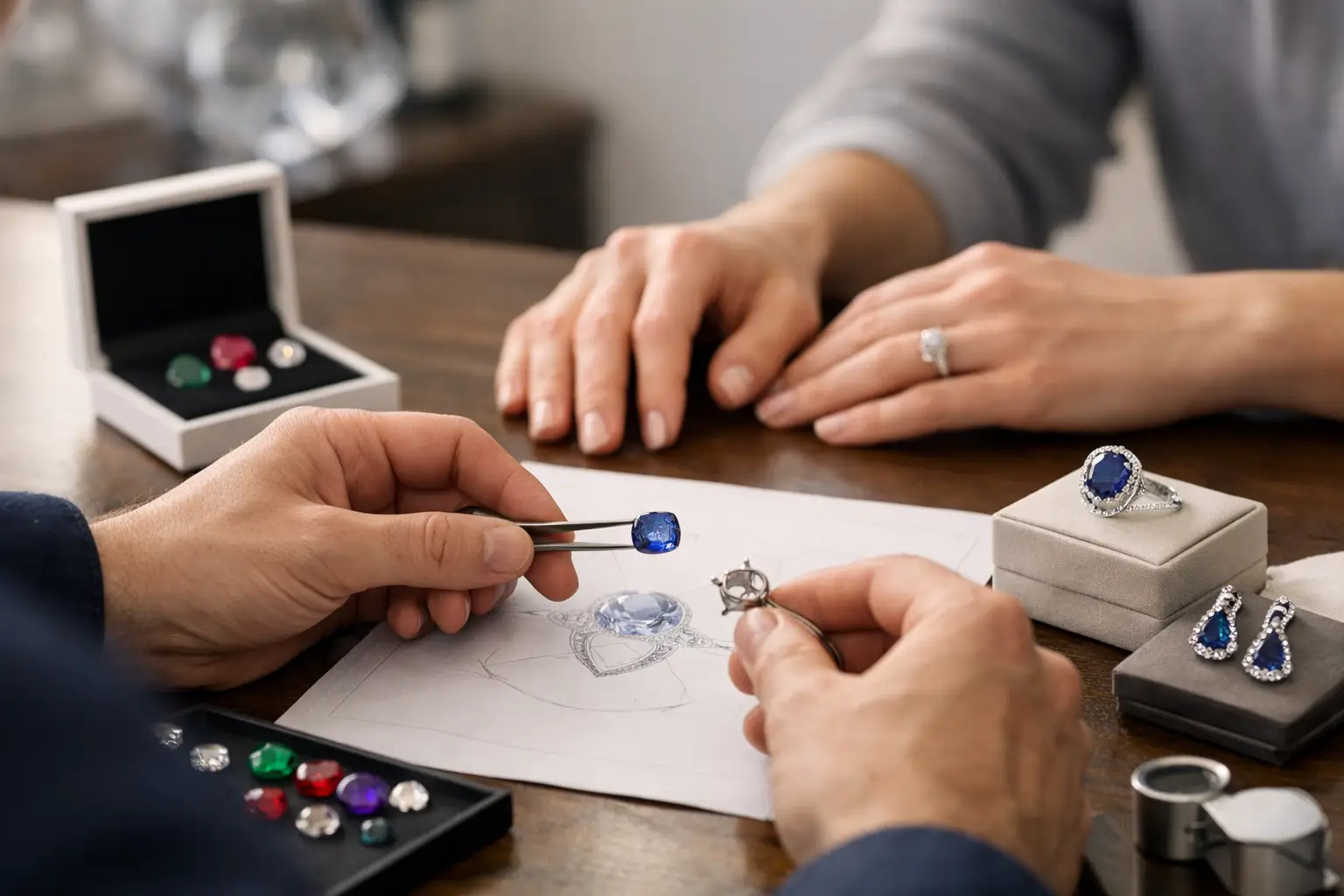
A fine ring can begin with a sketch, but the more memorable commissions begin with a gemstone held in the hand. Gemstone jewellery commissioning gives you the rare opportunity to choose not only how a piece looks, but what it represents: a particular blue found in a natural Ceylon sapphire, an anniversary date, a family connection, or simply a color you have never forgotten.
For an engagement ring or heirloom piece, that distinction matters. Rather than selecting a finished design and accepting the stone within it, you can let the individuality of a natural gemstone guide the entire process. The result is not a variation of something widely available. It is jewelry made around one exceptional stone and the person who chose it.
Why commission jewelry around a gemstone?
Natural gemstones are individual by nature. Two sapphires may share a weight and shape yet show entirely different personalities: one may have a crisp cornflower blue, another a deeper inky tone; one may be perfectly clean to the eye, while another has fine natural inclusions that speak quietly to its formation.
Commissioning allows the design to respect those differences. A low, protective setting may be right for a sapphire intended for everyday wear. A more open, light-filled design might suit a vivid spinel or an unheated stone whose color deserves to be seen from every angle. The setting, metal, proportions, and accent stones can all be considered in relation to the center gem instead of being decided in isolation.
It also creates room for choices that are difficult to find in ready-made jewelry. You may prefer an elongated cushion sapphire over a standard oval, a teal-and-blue bi-color stone rather than a conventional blue, or an old-world yellow gold setting for a pale pink sapphire. None is inherently better. The right direction is the one that feels true to the wearer and practical for how the piece will be used.
Begin with the stone, not the setting
The strongest commissions usually start with a clear conversation about the gemstone. Color is often the first consideration, but it should not be the only one. A beautiful gem is a balance of hue, tone, saturation, brilliance, cut, clarity, size, and durability.
For many clients, natural Ceylon sapphires offer an especially compelling starting point. Sri Lanka has a long gemstone heritage and is known for sapphires in an exceptional range of colors, from classical blue and luminous yellow to delicate pink, green, white, teal, and rare padparadscha shades. Their appeal lies partly in this variety. A sapphire does not need to be blue to feel timeless.
Treatment status should be discussed early as well. Heating is an established practice in the gemstone trade and can improve a sapphire’s color or clarity. Unheated sapphires are rarer and can carry a significant premium when they have desirable natural color and appearance. Neither choice should be treated as a simple measure of quality. An excellent heated stone can be a wonderful choice, while an unheated stone may be especially meaningful to a collector or someone drawn to its fully natural character. What matters is that the treatment status is accurately represented and understood before the design is finalized.
Origin can add another layer of significance. A Sri Lankan sapphire with known provenance connects a finished piece to the island’s mining tradition and skilled gem trade. At Ceyloe, direct relationships with family-owned mines help make that story more personal, while careful selection keeps the focus where it belongs: on the quality and character of the individual gemstone.
Shape changes the design conversation
A gemstone’s shape has a practical effect on every part of the commission. An oval can create elegant length on the finger. A cushion often feels soft and balanced, particularly in a solitaire or halo. Emerald cuts and other step cuts favor clarity and clean geometry, while pear and marquise shapes can make a more expressive statement.
Do not choose a shape from photographs alone. Proportions matter. A well-cut sapphire can appear larger, livelier, or more refined than another stone of the same carat weight. Viewing a gem in different lighting and, where possible, against the hand gives a far more useful impression than numbers on a certificate.
How gemstone jewellery commissioning takes shape
Once the center stone is chosen, the design process becomes more focused. A good jeweler will ask questions that go beyond visual references. Will the ring be worn daily? Does the wearer work with their hands? Is the preference for crisp modern lines, antique-inspired detail, or restrained simplicity? Does the piece need to sit comfortably beside a wedding band?
These answers help determine the setting. Platinum offers strength and a naturally white appearance that suits cooler-toned stones and diamonds. Yellow gold can enrich a yellow sapphire, soften a pale blue stone, or create beautiful contrast with teal and green gems. Rose gold is often flattering with pink, peach, and padparadscha sapphires, though personal taste should lead the decision.
The metal choice is only one part of the engineering. Prongs must protect vulnerable points, particularly on pear, marquise, and princess-style cuts. A bezel can offer excellent security and a clean, contemporary profile, but it may cover a little more of the stone. A cathedral setting gives presence and allows light beneath the gem, though it can sit higher. Every option has a trade-off between profile, protection, visibility, and ease of wear.
Small details make the commission feel considered rather than overdesigned. Tapered side diamonds can frame an oval sapphire without competing with it. A finely textured band may add character to a simple solitaire. An engraving inside the shank can hold a date, initials, or private message. The aim is not to add every possible feature. It is to choose the few details that support the stone and the story.
Set a budget with room for the important decisions
A custom piece is best approached with a realistic overall budget that includes both the gemstone and the finished setting. The center stone often accounts for the largest share, particularly for an exceptional natural sapphire, but metal, diamonds, design complexity, and hand-finishing all affect the final cost.
It is helpful to decide early where you are willing to compromise and where you are not. Some clients prioritize a larger face-up size and are open to a lighter tone or small natural inclusions. Others prefer intense color, an unheated status, or a specific Sri Lankan origin, even if that means choosing a smaller stone. There is no universal hierarchy. A trusted specialist should explain the available paths clearly rather than pushing a single definition of value.
If the piece is intended for daily wear, it is also wise to prioritize craftsmanship over unnecessary ornament. A beautifully built solitaire with a remarkable gemstone will generally remain satisfying longer than a complicated design that distracts from its center.
Questions worth asking before you approve the design
The commission should feel transparent from the first viewing to final collection. Ask whether the gemstone is natural, what treatments it has received, and whether its origin is known. For significant stones, ask about accompanying documentation and how the stone will be described on the final paperwork.
You should also understand the practical details: the estimated timeline, the approval stage for design drawings or renders, the ring size, care recommendations, and any resizing limitations. Some designs can be resized easily; others, particularly those with stones set around the full band or intricate engraving, require more planning.
Photography and digital renders are useful, but they are not substitutes for discussing scale. A setting can look delicate on a screen and substantial on the hand. If you are commissioning remotely, ask for clear videos of the loose gem in varied lighting and for dimensions alongside carat weight. These details bring confidence to a decision that is both emotional and technical.
A piece that becomes more yours over time
The real value of a commissioned jewel reveals itself in wear. A sapphire that first caught your attention for its color may later remind you of the day you chose it, the person who shared the decision, or the place it marked in your life. Fine jewelry gathers meaning gradually.
Choose the stone that holds your attention, then give it a setting worthy of its character. When the design is honest about the gem, comfortable to wear, and made with care, it will never need to follow a trend to feel personal.
