
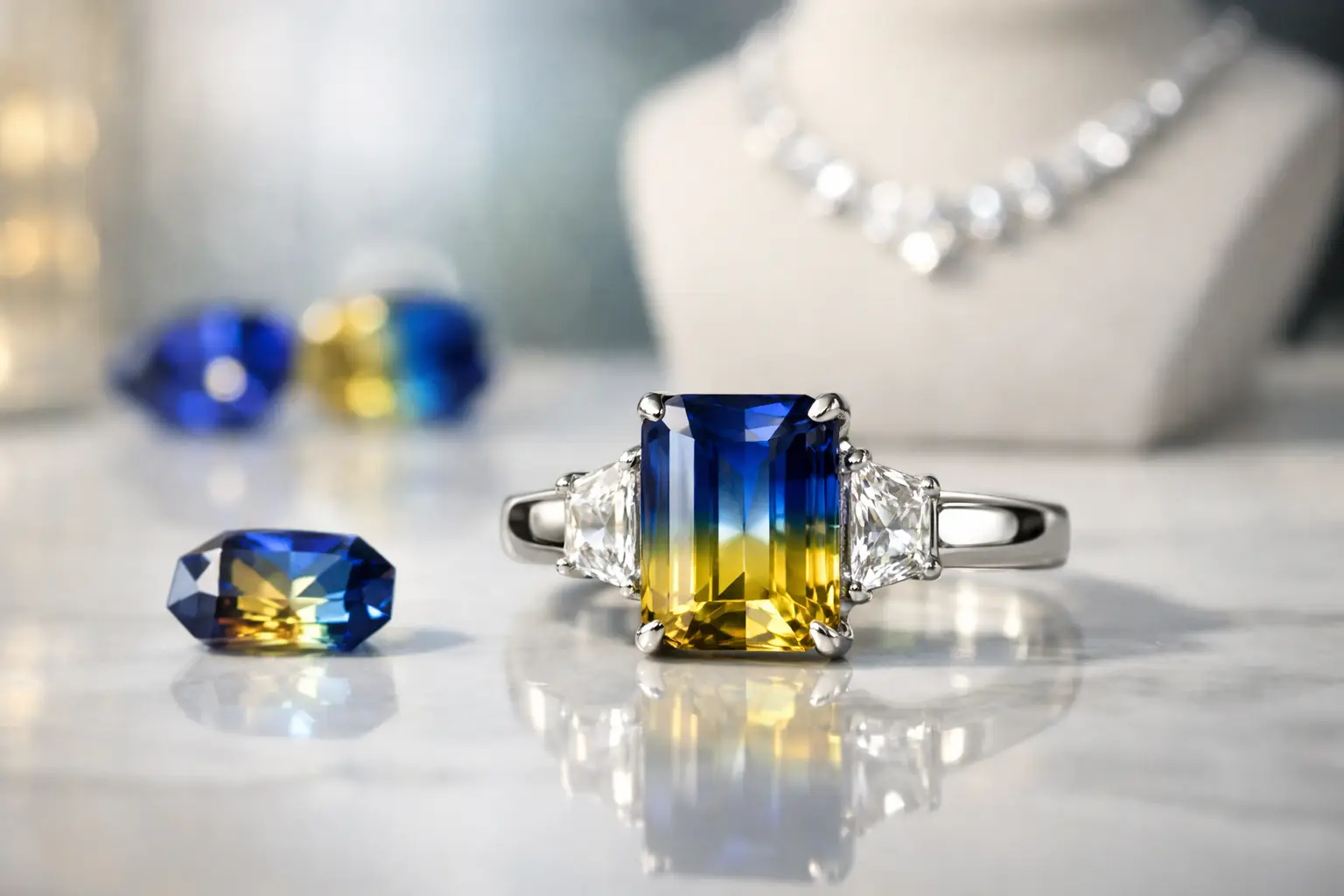
A bi-color sapphire may show blue flowing into yellow, green meeting gold, or teal softened by a second hue within the same stone. The bi-color sapphire meaning begins with that natural meeting of colors. For some, it represents balance, change, or two lives coming together. For others, its appeal is simpler and more lasting: no two are alike.
Unlike a gemstone chosen for one perfectly even shade, a bi-color sapphire is valued for its personality. Its color arrangement is created during crystal growth deep within the earth, making each stone a small record of the conditions that formed it. This individuality makes bi-color sapphires particularly compelling for engagement rings, custom jewelry, and collectors who prefer a gemstone with a distinct point of view.
Bi-Color Sapphire Meaning and Natural Symbolism
There is no single historical or scientific definition of a bi-color sapphire’s symbolic meaning. Gemstone symbolism is personal, shaped by culture, memory, and the colors a wearer is drawn to. Still, the visible combination of hues gives these sapphires a natural emotional resonance.
Blue and yellow can suggest calm confidence alongside optimism. Blue and green may evoke the meeting of sea and landscape, while teal and gold often feel both grounded and luminous. In an engagement ring, two colors can be read as a quiet expression of partnership: two distinct qualities held within one enduring stone. A bi-color sapphire can also mark a transition, a new chapter, or a connection to more than one place or person.
It is worth separating symbolism from gemstone fact. A natural sapphire does not need an assigned mystical property to be meaningful. Its true significance often comes from the moment it is selected, the person who wears it, and the care taken to understand its origin and character.
Why One Sapphire Can Show Two Colors
Sapphire is a variety of corundum, a durable mineral colored by trace elements present as its crystal develops. Small changes in those elements, and in the environment surrounding the growing crystal, can produce different colors in different areas of the same rough stone. This is known as color zoning.
In a bi-color sapphire, that zoning is visible after cutting. The colors may appear as clearly separated sections, soft bands, angled flashes, or a gradual transition. A cutter’s skill matters greatly. The orientation of the rough determines whether the finished gem presents its two colors beautifully, conceals them, or produces an uneven-looking face-up result.
The term parti sapphire is often used for sapphires showing two or more distinct colors, especially blue, green, and yellow combinations. In the jewelry world, bi-color is a helpful, widely understood description for a stone where two hues are the main feature. Naming can vary between sellers, so the stone itself should always be the focus: its colors, clarity, cutting, treatment status, and overall beauty.
The Appeal of Ceylon Bi-Color Sapphires
Sri Lanka has been admired for centuries for its exceptional variety of natural sapphires. The island’s gem gravels yield stones across an extraordinary spectrum, from cornflower blue and delicate pink to yellow, green, teal, padparadscha, and striking bi-color material.
A Ceylon bi-color sapphire often has a brightness that is especially attractive in daylight. Many show fresh, open color rather than a dense or overly dark appearance. That does not make every Sri Lankan stone inherently superior, as quality must be assessed individually, but provenance provides valuable context when it is known and properly represented.
For clients who value a meaningful connection to place, a sapphire from Sri Lanka carries a tangible link to one of the world’s great gemstone traditions. At Ceyloe, the enduring appeal of these stones lies not in forcing them into uniformity, but in selecting natural gems whose color patterns, life, and provenance deserve to be seen.
Is a Bi-Color Sapphire Rare?
Bi-color sapphires are less common than commercial single-color sapphires, but rarity is not measured by the presence of two colors alone. A stone with muddy tones, poor transparency, or an awkward distribution of color may be plentiful and less desirable. A bright, clean sapphire with an attractive and well-balanced pairing of colors can be much harder to find.
The most sought-after examples tend to have distinct yet harmonious hues, good transparency, and a cut that allows both colors to remain visible from the top. A pleasing blue-and-yellow or teal-and-gold stone may command a premium when the color is vivid, the crystal is clean, and the proportions are refined. Larger sizes, unheated status, and documented Sri Lankan origin can add further rarity and value.
There is also a practical trade-off. Strongly zoned stones are inherently individual, which means it can be difficult to find a precise match for earrings or a future replacement. For a ring or pendant, however, that singularity is often exactly the point.
Color Changes With Light and Orientation
A bi-color sapphire should never be judged from a single photograph. Its colors can look quite different in daylight, indoor lighting, and warm evening light. Some stones reveal both hues immediately, while others show one dominant color face-up and a second tone when tilted.
This is not necessarily a flaw. A subtle secondary color can make a sapphire feel nuanced and sophisticated. Yet a buyer hoping for a clearly defined two-color effect should ask to see the stone from different angles and under more than one light source. Video is useful, but viewing a gemstone in person remains the best way to understand its personality.
Cut also shapes the visual result. A long oval, cushion, emerald cut, or freeform shape may emphasize bands of color differently. Facets can blend the hues into a lively mix, while a more open facet pattern may preserve stronger color separation. There is no universally best cut. The right choice depends on whether you prefer a painterly blend or a more graphic division between colors.
Treatment, Authenticity, and Value
As with all fine sapphires, treatment status should be clearly disclosed. Heat treatment is an accepted and common practice in the sapphire trade, and it can improve color or clarity. A heated bi-color sapphire can still be beautiful and valuable, particularly when it has strong color and good transparency.
Unheated bi-color sapphires are generally more uncommon and may command a higher price when other quality factors are favorable. The word unheated should not be treated as a substitute for beauty, though. An unheated stone with a weak cut or gray appearance is not automatically preferable to a well-cut heated stone with exceptional life.
For a significant purchase, ask what is known about origin, whether the stone has been heated, and whether an independent gemological report accompanies it or is available. Natural inclusions are common in sapphires and can support the understanding that a stone is natural, but clarity should be considered in relation to the gem’s overall appearance. A small inclusion may be acceptable in a lively, unique stone; one that compromises durability or dominates the face-up view is more consequential.
Choosing a Bi-Color Sapphire for a Ring
Sapphire rates 9 on the Mohs scale of hardness, making it an excellent option for regular wear. Still, a ring setting should protect the gemstone’s vulnerable areas. Corners in a rectangular or sharply shaped stone benefit from secure prongs, while a low bezel can offer a more protective, contemporary finish.
When selecting a bi-color sapphire for an engagement ring, begin with the colors you want to see most often. If blue is meaningful, look for a stone that keeps a clear blue presence face-up rather than one that turns predominantly green indoors. If the two-tone effect is central to the design, choose a gem with a visible division or transition that remains attractive from normal viewing distance.
Metal choice can quietly influence the result. Yellow gold often enriches yellow, green, and golden zones, while white gold or platinum can create a cooler frame around blue and teal. Rose gold may bring warmth to peachy, pink, or golden secondary tones. The metal should support the sapphire, not compete with its natural color pattern.
A Gemstone That Does Not Repeat Itself
The most compelling bi-color sapphires resist easy categorization. Their colors may shift with the light, their zoning may resemble a landscape or nothing at all, and their value is as much about character as it is about conventional grading. That makes them a thoughtful choice for someone who does not want a gemstone selected from a standard formula.
Choose the stone that continues to hold your attention after the first glance. A fine bi-color sapphire offers more than two colors in one gem: it offers an individual story, formed naturally and carried forward in a piece of jewelry made to be worn for years.
Comment (1)