
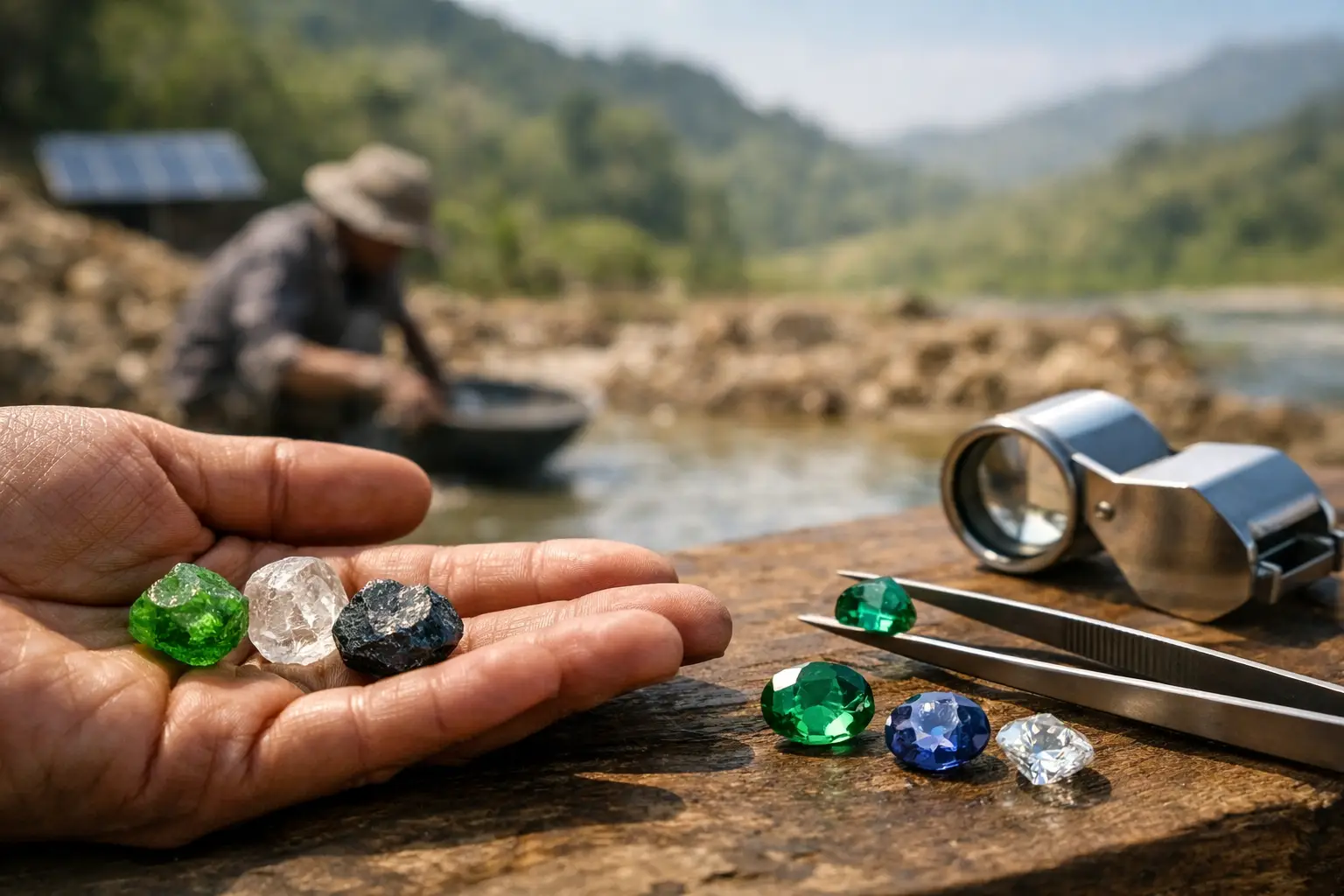
A sapphire can carry a remarkable story: formed deep within the earth, brought to light by skilled hands, then chosen for a ring, a pendant, or a future heirloom. Ethical gemstone sourcing asks a simple but consequential question about that story: who was involved, how were they treated, and how clearly can the journey be understood?
For anyone selecting a natural gemstone, especially a significant engagement stone or collector-quality sapphire, beauty and rarity are only part of the decision. A known origin, honest treatment disclosure, and a credible relationship with the people closest to the source can give a stone a deeper sense of value. They also help buyers make a considered choice without pretending that a complex global trade has easy answers.
Ethical Gemstone Sourcing Begins With Real Relationships
Gemstones do not emerge from a single, uniform supply chain. Mining practices vary between countries, regions, and even neighboring mines. In Sri Lanka, much gemstone mining is small-scale and family-operated, often using traditional methods passed down through generations. This is very different from the image many people hold of large industrial extraction.
Small-scale mining can support local families, preserve specialist knowledge, and create a direct economic link between a valuable natural resource and the community that finds it. Yet small scale alone does not automatically make a gemstone ethical. Working conditions, fair payment, environmental practices, and the presence of intermediaries still matter.
The most meaningful starting point is a direct and enduring relationship. When a gemstone house knows the miners, dealers, and cutters involved, it has a clearer view of how a stone entered the market. It can ask better questions, make more informed selections, and avoid treating provenance as a vague marketing term.
At Ceyloe, close family connections to Sri Lanka’s gemstone trade and access to family-owned mines make those conversations personal rather than distant. That proximity does not make every part of the journey perfect or simple. It does mean sourcing can be approached with care, familiarity, and accountability.
Why Country of Origin Is Not the Whole Story
“From Sri Lanka” is meaningful information, particularly for a natural Ceylon sapphire. Sri Lanka is celebrated for sapphires with exceptional brightness, fine crystal, and a spectrum of colors, from classic blue to yellow, pink, teal, white, green, bi-color, and the rare pink-orange balance of padparadscha.
But origin is not a complete ethical claim. A country name tells you where a gemstone was found, or in some cases where it is understood to have originated. It does not, by itself, explain mining conditions, the route through local trading networks, or whether the seller has reliable firsthand knowledge of the stone.
A more useful question is: how does the supplier know what they are telling you? The strongest answer often comes from a combination of direct sourcing, long-standing trade relationships, documentation where available, and open disclosure about what is known and what cannot be verified.
This distinction matters because gemstone supply chains can be fluid. Rough material may move through several hands before cutting. A stone may be cut in a different city or country from where it was mined. Older stones may have changed ownership many times. Ethical practice is not about inventing certainty where none exists. It is about being precise, transparent, and unwilling to make claims that exceed the evidence.
Traceability Is a Practice, Not a Label
Traceability is often spoken about as though it were a certificate that settles every question. In reality, it is a spectrum.
At one end are stones with a well-recorded path from a known mine or mining family through cutting and sale. At the other are gemstones traded through large, anonymous channels, with little information beyond their type and apparent origin. Many natural gemstones sit between these points: their country of origin may be known with confidence, while every individual transaction in their history may not be documented.
For a buyer, the practical value lies in clear communication. A reputable specialist should be able to explain whether a gemstone was sourced directly, whether the mining area or mine is known, and which details are supported by records or trusted relationships. If a detail is uncertain, that should be stated plainly.
Documentation also has limits. A laboratory report can identify a gem species, confirm natural origin, describe detectable treatments, and sometimes offer an opinion on geographic origin. It is valuable, particularly for significant stones, but it is not a complete social or environmental audit. The best sourcing decisions combine laboratory expertise with knowledgeable human stewardship.
Questions Worth Asking Before You Choose
When considering a sapphire or colored gemstone, ask where it was sourced, whether the seller has direct relationships in that region, and how its journey is described. Ask about treatment, whether it is supported by a laboratory report, and whether the seller can distinguish known facts from assumptions.
These questions are not confrontational. They are part of buying well. A fine gemstone should be chosen with enough information to appreciate both its natural character and its place in the world.
Treatment Disclosure Is Part of Ethical Practice
Ethical sourcing is sometimes discussed only in terms of mining, but honesty about treatment is equally important. Treatments can materially affect a gemstone’s appearance, rarity, care requirements, and value. A beautiful sapphire is not diminished by transparent disclosure. Problems arise when a buyer is left unaware of what they have purchased.
Heat treatment is common in sapphires and has been practiced for generations to improve color or clarity. Heated sapphires can be beautiful, durable, and appropriate for fine jewelry, often at a more accessible price than comparable unheated material. An unheated sapphire, however, is rarer when it has appealing natural color and clarity, which can make it especially compelling to collectors and clients seeking a distinctive heirloom stone.
Other treatments may be more significant. Diffusion, fracture filling, dyeing, coatings, and various clarity enhancements can alter how a stone should be valued and cared for. The appropriate choice depends on the gemstone, the treatment, the price, and the buyer’s priorities. What is non-negotiable is full, understandable disclosure before purchase.
This is where ethical practice becomes very practical. A buyer who knows a sapphire is heated can assess it fairly. A buyer who is told a stone is natural without explanation may assume it is untreated. Clear language respects the client and protects the meaning of the purchase.
Environmental Care Requires Perspective
Every form of mining has an environmental footprint. It would be misleading to suggest otherwise. The relevant questions are the scale of extraction, water management, land restoration, local regulation, and whether mining is conducted with regard for the surrounding community.
Sri Lanka’s traditional gem mining is often relatively low-impact compared with extensive open-pit operations. Many deposits are recovered from gravel layers using hand tools and small pits, and mined ground may be backfilled after recovery. Still, practices vary. Responsible sourcing means recognizing better methods without turning them into a blanket guarantee.
For buyers, choosing a natural gemstone that is selected carefully, worn for decades, and potentially passed down through generations can be a thoughtful alternative to jewelry designed for short-lived trends. Longevity is not a substitute for responsible mining, but it is part of a more considered relationship with material objects.
The Human Value of Choosing Carefully
A gemstone’s value is often described in carats, color, clarity, cut, and origin. Those qualities matter. Yet the most memorable stones also have a human dimension: the miner who recognized rough crystal in the earth, the cutter who oriented it to reveal its color, and the person who selected it for a moment that matters.
Ethical gemstone sourcing does not require buyers to become supply-chain investigators. It asks them to choose specialists who welcome thoughtful questions, disclose treatments clearly, and speak honestly about provenance. It also leaves room for nuance. A stone with complete mine-to-market records may be ideal for one client; another may place greater weight on exceptional natural color, Sri Lankan origin, and the confidence of a trusted long-term source.
The right gemstone is not only the one that catches the light. It is the one whose story you can understand, whose natural qualities are represented truthfully, and whose place in your life feels worth preserving.
