
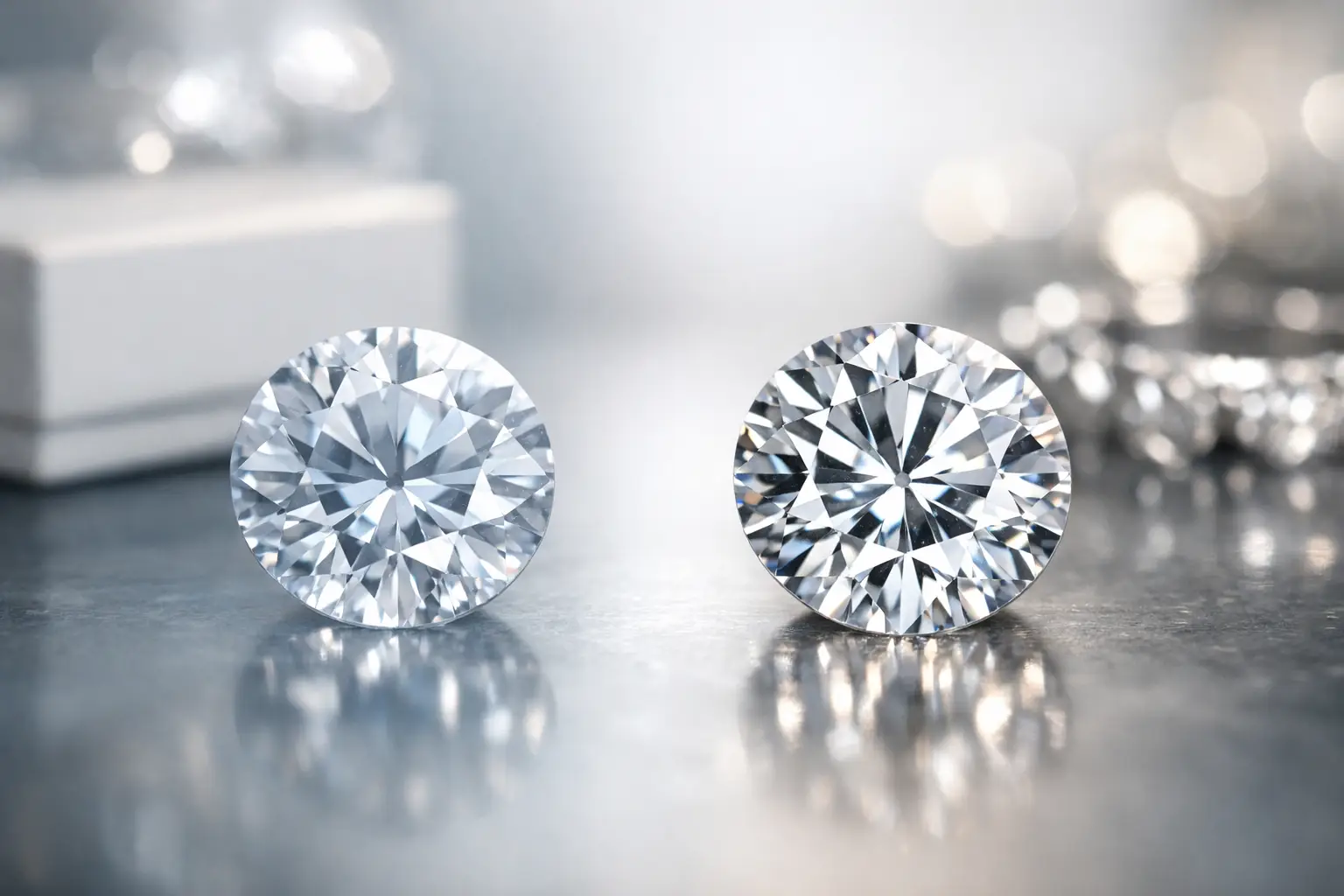
A white gemstone can look beautifully understated in a ring, but its character changes dramatically with the stone you choose. In the white sapphire vs diamond decision, the question is not simply which is better. It is whether you are drawn to diamond’s unmistakable fire and tradition, or the quieter, individual presence of a natural colorless sapphire.
For an engagement ring or heirloom piece, both can be meaningful choices. They differ in optical performance, durability, rarity, price, and the way they reveal their natural origin. Seeing them side by side is often the clearest way to understand which one feels right.
White Sapphire vs Diamond at a Glance
Diamond and white sapphire may both appear colorless, yet they belong to entirely different mineral families. Diamond is crystallized carbon and the hardest natural material used in jewelry. White sapphire is a colorless variety of corundum, the same family as blue, pink, yellow, and padparadscha sapphires.
A diamond has a hardness of 10 on the Mohs scale, while sapphire ranks 9. That single point represents a meaningful difference in resistance to scratching, though sapphire remains one of the most durable natural gemstones for everyday jewelry.
The visual distinction is just as significant. A well-cut diamond returns light with exceptional brightness and colored flashes known as fire. White sapphire has a more gentle, silvery brightness. It can be luminous and elegant, but it does not produce the same sharp scintillation or rainbow fire as diamond. This is not a flaw in white sapphire. It is part of its more restrained personality.
Brilliance: Crisp Fire or Soft Luminosity?
If sparkle is your highest priority, diamond is difficult to rival. Its high refractive index and dispersion create bright white reflections alongside flashes of spectral color. Even from across a room, a well-cut diamond tends to announce itself.
White sapphire reflects light differently. In a fine cut, it can look bright, glassy, and beautifully clear, especially in daylight. Yet it may appear softer or more transparent than diamond under lower light. Some people prefer this effect because it feels less conventional and allows the setting, metalwork, and overall design to play a larger role.
Cut quality matters greatly for both stones. A poorly cut diamond can look dull, and a poorly cut white sapphire can show areas of transparency or darkness that reduce its life. White sapphires are often cut to preserve weight from the original crystal, so proportions deserve close attention. A thoughtfully cut stone will show more even brightness across its face.
White sapphire can also develop a film of soap, lotion, and everyday residue more visibly than diamond, making regular gentle cleaning worthwhile. A clean stone will always show its best character.
Color is Still Relevant in a White Stone
The most desirable white sapphires are colorless or near-colorless. Natural stones can carry a subtle gray, blue, or yellow undertone, particularly when viewed beside a diamond. That faint tint is not necessarily undesirable. It can give a natural sapphire warmth and individuality, especially in yellow gold.
A diamond is graded on a formal color scale, from colorless through increasingly noticeable yellow or brown tones. With white sapphire, the assessment is more visual: how clean and bright does the stone look in the hand, and does its undertone suit the intended design?
Everyday Wear and Durability
For daily wear, both diamond and white sapphire are suitable choices when set well and treated with sensible care. Diamond’s superior hardness makes it more resistant to surface scratching over decades of wear. It is an excellent option for rings worn every day, particularly in designs where the stone is exposed.
Sapphire is also exceptionally practical. At 9 on the Mohs scale, it is harder than nearly every commonly used colored gemstone, including emerald, tourmaline, garnet, and zircon. A white sapphire engagement ring can be worn confidently, provided it is protected by a thoughtful setting and checked periodically by a jeweler.
Hardness is not the only measure of durability. Diamonds can chip if struck in the wrong direction because they have cleavage planes. Sapphires do not cleave in the same way, though they can still chip or fracture under force. A bezel, partial bezel, or well-designed prong setting offers added protection for either gemstone without sacrificing elegance.
Natural Origin, Treatments, and Transparency
A natural white sapphire offers a connection to the earth’s long geological history. Many fine sapphires are found in Sri Lanka, a source celebrated for centuries for its remarkable variety of corundum. In a natural colorless sapphire, delicate inclusions may be visible under magnification. These internal features can help confirm natural origin and give each stone its own fingerprint.
White sapphires may be untreated, or they may have been heated to improve color and clarity. Heat treatment is a longstanding and accepted practice in the sapphire trade, but it should always be disclosed. An unheated white sapphire is particularly appealing to clients who value a stone as close as possible to its natural state, though it may command a premium depending on its quality and rarity.
Diamonds require their own level of transparency. A buyer should understand whether a diamond is natural, laboratory-grown, or treated, as these categories differ substantially in origin, rarity, and price. Neither choice is inherently wrong. The meaningful distinction is having clear information before making a decision.
For those drawn to provenance, a natural Ceylon sapphire has a story that is distinct from a standardized white stone. Its appeal often lies in that individuality: a gem shaped by geology, selected for its particular clarity, cut, and presence rather than produced to match a broad commercial template.
Price and Size: Where White Sapphire Can Shine
A white sapphire is generally more accessible in price than a comparable natural diamond. This can allow a buyer to choose a larger center stone, invest in a more detailed custom setting, or direct more of the budget toward craftsmanship.
However, price should not be mistaken for value alone. A fine natural, unheated white sapphire with excellent clarity and a strong cut is not a budget substitute. It is a distinctive gemstone with its own place in fine jewelry. Its value is shaped by natural origin, treatment status, cut quality, transparency, size, and overall beauty.
Diamond pricing is influenced by the familiar combination of carat weight, cut, color, clarity, and certification. At larger sizes, especially in high color and clarity grades, the price difference between diamond and white sapphire can become considerable.
There is also a visual consideration around size. White sapphire is less dense than diamond, so stones of the same carat weight may not have identical face-up measurements depending on their cut. When designing a ring, millimeter dimensions are often more useful than carat weight alone.
Which Stone Fits Your Ring Design?
Diamond works naturally in designs built around brilliance: solitaire rings, pavé bands, halo settings, and refined modern pieces where the center stone is intended to sparkle intensely. Its neutral color also pairs easily with any metal, from platinum to yellow or rose gold.
White sapphire suits many of those same designs, but it can be especially compelling in a piece with a softer, more individual aesthetic. It looks striking in warm yellow gold, antique-inspired settings, sculptural bezels, and designs that place natural gemstones at the center of the story. A white sapphire can also be a beautiful choice for someone who prefers a gemstone that feels personal rather than expected.
Consider your lifestyle, too. Someone working regularly with their hands may prefer a low-profile bezel setting regardless of whether they choose sapphire or diamond. Someone who wants a large, bright center stone within a considered budget may find white sapphire particularly appealing. Someone who wants maximum fire and the established symbolism of a diamond may feel that no alternative quite replaces it.
Choosing With Your Own Priorities
The best choice becomes clearer when you stop treating white sapphire as an imitation of diamond. A white sapphire is a sapphire first: a natural corundum gemstone with enduring strength, quiet brightness, and a character all its own. A diamond is prized for exceptional light performance, rarity, and a long association with engagement jewelry.
If possible, look at well-cut examples in natural light and indoors. Notice not only how much they sparkle, but how they make you feel. The right stone is often the one you continue thinking about after the comparison is over.
